


When my husband and I first moved to Raleigh, we spent months looking for a house in an older part of the city, near downtown. One of the houses we visited originated as a small box in the late 1800s. Over the years, a kitchen was added here, a bedroom there, a porch off the back. I’m quite sure every addition made sense at the time, but the result was unexpected steps, sloped floors, odd hallways, and cattywampus walls.
Some manuscripts are built this way.
An author has a manuscript with twelve chapters, perhaps divided into three parts. The table of contents offers chapter titles that seem logical. Everything looks organized.
But when you read the manuscript, you discover that important concepts are referenced before they’re explained, related material is scattered across chapters, ideas are repeated unnecessarily, and the progression makes sense only to the author.
The appearance of organization doesn’t guarantee a good reading experience. A book needs good structure.
What a good book structure does
Just as an architect defines the structure of a building with blueprints, an author must define the structure of their book. Both require asking: What are you trying to build, and who is it for?
There’s a huge difference between building a cobbled-together cottage, a beautiful Not So Big House, a municipal office building, and a museum. They serve different purposes for different clientele, and their architecture reflects that.
Regardless of a nonfiction book’s subject or genre (e.g., memoir, how-to), a good book structure generally helps readers:
- Understand the relevance of the material as it’s introduced.
- Follow the author’s argument, explanation, or narrative without unnecessary friction.
- Make connections among ideas and build on what they’ve already learned.
- Reach the understanding, outcome, or resolution the book promises.
Structure is part of what creates the reader’s journey through a book, the experience they have. It’s more than just an outline—it’s something you design, test, and refine as you develop the manuscript.
First, uncover your existing structure
Before you can assess your book’s structure, you need an objective picture of what you have. Wading through prose can be cumbersome, so I regularly use three tactics to make the structure visible on an existing manuscript:
- Apply heading styles so you can generate an automatic table of contents (TOC). This lets you more easily view an outline of the book’s structure in the TOC and navigation pane.
- Simplify chapter titles, headings, and subheadings to accurately describe what’s in the section (not what you wish was in the section). Avoid clever and catchy language; you can cute things up later, but for now, focus on function.
- In the headings, add short tags (I like to use ALL CAPS) to indicate major topics. This helps spot the same topic unnecessarily scattered about.
Once the pieces of the manuscript are clearly labeled, you can begin to analyze the visible structure, and—with the five questions below—decide what adjustments are needed. Sometimes I work in the document, refreshing the TOC as needed; sometimes I print out the TOC so I can literally cut and paste.
Next, use strategic questions to assess your book’s structure
To assess whether your manuscript’s structure works for your reader, the trick is to shift from looking at it as the person who wrote it to looking at it as someone encountering it for the first time.
I use five questions repeatedly, beginning at the book level and continuing at the chapter level, working iteratively and asking whichever question is needed at the time (you don’t have to use them in this order).
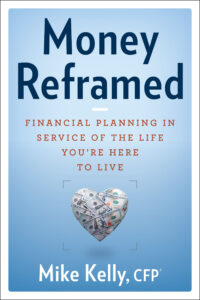
Here I’ll walk you through the questions using examples from the work Mike Kelly and I did on his forthcoming book, Money Reframed: Financial Planning in Service of the Life You’re Here to Live.
Q1. Is related material grouped appropriately?
With this question, we are looking for concepts that are scattered across the manuscript, chapters or sections that overlap, and unnecessary repetition.
Mike’s original manuscript structure comprised four parts:
- Rethinking Priorities: Why Financial Literacy Often Takes a Backseat
- The Power of Vision: Why It Matters for Your Financial Future
- Turning Dreams into Reality: How to Define and Achieve Financial Freedom
- Mastering Money: The Essential Guide to Building Wealth, Achieving Balance, and Securing Your Financial Future
On the surface, those titles aren’t illogical, but the content in each section did not reflect its title, and there was a lot of repetition across parts. So I tagged the various topics: FINANCIAL LITERACY, MINDSET, LIFE PLANNING, FINANCIAL TOOLS, and so on. That made way for reorganizing.
Q2. Does the overall progression make sense for the reader?
In nonfiction books we are generally looking for each chapter to follow logically from the previous one: The order should reflect what readers need to understand when, rather than the sequence in which you developed the ideas.
To broaden the question: Why does this material appear here, and what effect does that placement have on the reader?
With Money Reframed, Mike’s central premise was that your money should support your life goals, so the most important topic of the book was life planning: What do you want your money to do for you? But many of us have “cleanup” work to do on our mindset so we can see both our life possibilities and our finances more clearly.
With this understanding and having grouped the information more effectively (from the prior question), we began to see a new structure emerge:
- Part 1. Break old narratives
- Part 2. Choose your direction
- Part 3. Steward your resources
- Part 4. Maintain alignment
This high-level structure would continue to evolve.
Q3. Does each chapter have a clear purpose?
Beyond naming its topic, you should be able to articulate what each chapter contributes to the book’s larger purpose. One way to test each chapter is to write out a paragraph or two that describe the chapter, its purpose, and its key points. If you struggle with justifying a chapter, it’s probably time to rethink it.
For Money Reframed, Mike wanted each chapter to reframe something about its topic. So for each, we asked:
- What is the reader coming into the chapter thinking or believing?
- What reframe, aha, or shift do we want them to have by the end of the chapter?
We used a temporary REFRAME tag in headings to remember to define this in each chapter. These are examples of “reframe” concepts we wanted to define:
- Budgeting is not synonymous with spending less. It simply means aligning a dollar amount to a purpose. Maybe you need to spend more.
- Insurance is a method of risk management. You can choose to transfer risk by buying insurance or accept some risk yourself—aka “self-insure.”
Once the chapters were revised, we removed the tags and prettied up the headings, but the exercise helped us ensure the book provided the broader perspective Mike wanted it to.
Q4. Do readers have everything they need?
Poor structure can hide gaps in the book’s content. When a subject is strewn throughout a book, how do you know what’s missing? Additionally, authors often know so much about their topic that they make assumptions, skip explanations, or leave important connections unstated. Creating a clearer structure lets you ask: If I were a reader, what else would I be expecting?
For Mike, we identified one big book-level gap: We needed more stories and examples to demonstrate the points he wanted to make. But most of the informational gaps we found were at the chapter level. In the insurance chapter, we had forgotten annuities, which can protect against outliving your assets. In the estate planning chapter, we were missing a discussion of legacy giving.
Pro tip: When you’ve sorted your structure and filled the gaps you can identify, alpha and beta readers can let you know what else you might have missed.
Q5. Does the emphasis match the importance of the material?
With this question, we consider whether minor topics are receiving disproportionate attention and whether something central to the book needs more development. Not only does this help provide the right level of detail to readers, but it also affects things like pacing and comprehension: “Oh, this is a drag—I’ll just skim” or “Wait, that went too fast—I don’t get it.”
Interestingly, with Mike’s book, we had two pretty drastic examples at the opposite ends of the spectrum.
Because Mike’s core message was about using money to support your life, in our initial structure, we thought we could focus more of the book on mindset and life planning and abbreviate the discussion of traditional personal finance topics such as budgeting, saving, and investing.
Nope. That just did not work. For a reader to have enough useful information to create a financial plan in support of their life, they needed a chapter on each of those standard financial topics. That section ended up being half of the book’s word count.
By contrast, our initial draft had 1,200 words on who was responsible for financial literacy—a useful philosophical discussion but only one portion of one chapter. In our last revision pass, we realized it was a slog to read and chopped it down to 300 words—without eliminating the topic or leaving the audience confused. It simply didn’t need as much space as we had given it.
Let me emphasize: Neither decision was about word count. Both were about giving the material the space and emphasis it deserved in service of the book’s purpose.
Structure with intention
After all that organizing, rearranging, and revising, here’s where the four-part structure of Money Reframed landed (with fourteen clearly defined chapters):
- Part 1: Understand Your Money Story
- Part 2: Envision the Life You Want
- Part 3: Explore Your Financial Toolkit
- Part 4: Put Your Money in Service of Your Life
The final book is cohesive, designed to help readers feel grounded in their understanding of financial planning and inspired to take action toward their life goals.
Now, let’s return to our cobbled-together cottage to make one last point…
Good structure doesn’t necessarily mean simple or straightforward structure. A Not So Big House might be the same size as our cobbled-together cottage, and its design can be equally complex. But its spaces are thoughtfully arranged, and intricate details work together to make the house more functional and enjoyable to live in.
The same is true of books. There’s a difference between intentional complexity and accidental confusion. You don’t necessarily want to eliminate surprise, ambiguity, or intellectual work for the reader. You want those qualities to be there because the author chose them, not because the manuscript hasn’t been adequately structured.
The goal isn’t to make every book “easy”—it’s to make its architecture purposeful so the reader has the experience you intend.
Figuring out book structure is one of my favorite parts of the editorial process—and one of my strengths. If that’s what you’re struggling with and want some help, get in touch at karin@clearsightbooks.com.
Related Reading
For this article I’m focusing on book structure itself. If you need help clarifying what you’re building and who it’s for, take a look at:
- How to Begin Writing a Nonfiction Book. Aligning audience, purpose, and subject.
- The One Sentence That Gives Your Book Its Focus. Finding your core message.
- Reader Personas: Know Your Audience. Understanding your reader.
- What type of nonfiction book should you write? Deciding on memoir vs. knowledge-based book.
- Nonfiction Book Structures: Familiarity Helps Readers. These common structures might help you get started.